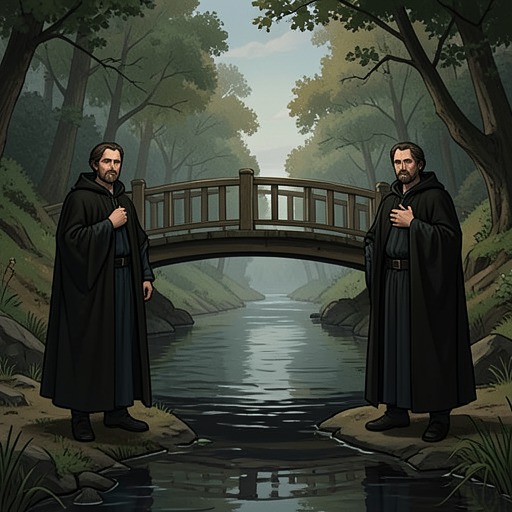
Warmin
De brief voor de KoningWarmin, known as the Waker at the Toll, guards the Rainbow River crossings and commands armed men in the service of the toll lord. He first warns Tiuri and Piak that the river cannot simply be crossed wherever they please; later he arrests them for trying, then rides out to protect them from a danger the toll lord fears. His role changes without abandoning its central principle: the crossing and the people who use it must be guarded, whether that means enforcing a rule or helping travelers in peril.
Identity and First Encounter
Warmin is introduced while Tiuri and Piak are considering how to get across the Rainbow River. A field worker named Ferman has been watching the two friends; when he joins them, Warmin greets him and calls him the Waker at the Toll. Ferman points out that other crossings are guarded too: there is another toll to the northwest, one in the south at the Toll of Rainbow Mountain Country, and another farther upstream at the Toll of Vorgóta. Warmin confirms that the toll lords guard the whole river, and adds that a toll is also collected at a place on the Silver River. The geography of the river is thus presented not as open passage but as a chain of controlled crossings.
Warmin is neither merely a distant official nor a guide who can make the rules disappear. He tells the boys they can seek food and lodging from the steward, as an advance on work, and gives Tiuri a practical warning before leaving: even if they could obtain a boat, navigating an unfamiliar river would be dangerous. His advice anticipates the choice the boys make. They know the crossing is watched and risky, but still search for a way around it.
From Warning to Arrest
The warning becomes action when Warmin encounters the friends again aboard a boat. He is at the stern, directing the rowers to put the oars to starboard as the vessel approaches the rock where the boys are waiting. Once the boat is safely under way, he identifies himself as the toll guard they had spoken with the previous day and declares them prisoners of the toll lord for trying to evade the toll. The encounter confirms that his earlier advice was not an idle opinion: he is part of the system that patrols the river and enforces its restrictions.
Yet his authority is not expressed as simple harshness. Warmin asks why the boys ignored his counsel, but when Piak is shivering, he takes off his own cloak and puts it around him. The boat rows upstream toward the bridge and castle, and Tiuri asks to speak to the toll lord. Warmin initially refuses the request, saying that the time for apologies has passed. Tiuri answers that he is not sorry he tried to cross, only that the attempt failed. The exchange sets their different positions plainly: Warmin represents the consequences of breaking the toll rules, while Tiuri will not pretend regret merely to make his predicament easier.
The Toll Lord’s Envoy and Protector
Warmin’s role shifts when Tiuri later encounters armed riders and doubts their claim that they come from the toll lord. The commander proves his identity by throwing down his weapons, allowing Tiuri to hear and recognize his voice. Warmin then approaches the hiding place alone. To establish that the message is genuine, he calls Tiuri by the name Martijn and relays the toll lord’s appeal, invoking the small keepsake they both know and asking Tiuri to accept the help of his servants. Tiuri feels the ring at his chest, sheathes his dagger, and agrees to hear him. Warmin also explains that his men do not carry their shields outside the Rainbow River territory, a detail that ties the escort’s equipment to the jurisdiction he serves.
The protection has been organized because the toll lord fears that the boys may be in danger. After hearing of a suspicious man at the bridge, he ordered Warmin to take ten armed men, catch up with Tiuri and Piak, accompany them, and protect them even at the cost of their own lives. The concern had been sharpened by news from the second messenger from Dangria. Warmin recounts this chain of information so Tiuri can understand why the riders have come, rather than asking him to trust an unexplained show of force. Tiuri accepts the escort.
When a man is found dead, Warmin turns immediately to what must be done: the body cannot be left there, the killer must be caught, and news must reach Dangria and the king, or at least Ingewel, where a messenger can be found. He suggests that the men of Sir Andomaar can help search and that the murderer may have fled toward Ingewel. Tiuri and Piak cannot wait, however, and Warmin offers to send three of his men to deal with the dead man and carry the news while he continues with the boys. Tiuri agrees. Warmin’s protection therefore includes practical arrangements for the victim and the pursuit of the killer, not only the safety of the travelers he has been ordered to accompany.
Authority, Trust, and Return
Warmin carries the toll lord’s glove beneath his mail as proof that he is acting under orders. When he presents it to a knight, the knight recognizes it and understands why the toll lord has sent armed men; he says that troubling things are happening despite the appearance of peace. The glove makes Warmin’s authority visible and verifiable. His service is personal in its risks, but it is also backed by a formal chain of command, and the knight expects Warmin and Tiuri to return and testify in the case against Slupor, who remains the knight’s prisoner.
Later, when Tiuri and Piak cross the Rainbow River bridge again, the toll guards do not recognize them at first. Warmin arrives, greets them warmly, and then takes them into the castle to report their arrival to his lord. He knows by then that they have brought important news to the king, though he does not yet know its full contents. The toll lord refuses the money Tiuri has brought for the toll, saying it has already been paid, probably by the lord himself. Warmin’s greeting marks the distance traveled since their first meeting: the boys who tried to evade the guarded river return as recognized guests, and the official who once arrested them now welcomes them into the castle.
Warmin’s sequence of appearances gives the river crossing a human as well as political dimension. He enforces a system that frustrates Tiuri and Piak, but does not confuse enforcement with indifference: he warns them, cares for Piak when he is cold, lays down his weapons to establish trust, and undertakes a dangerous escort on the toll lord’s orders. His loyalty is not a sudden rejection of his office; it is the way he fulfills it when the boys’ safety becomes part of his charge.